
RESEARCH USE ONLY · NOT FOR HUMAN OR VETERINARY CONSUMPTION · HPLC & LC-MS VERIFIED · CASH APP & VENMO
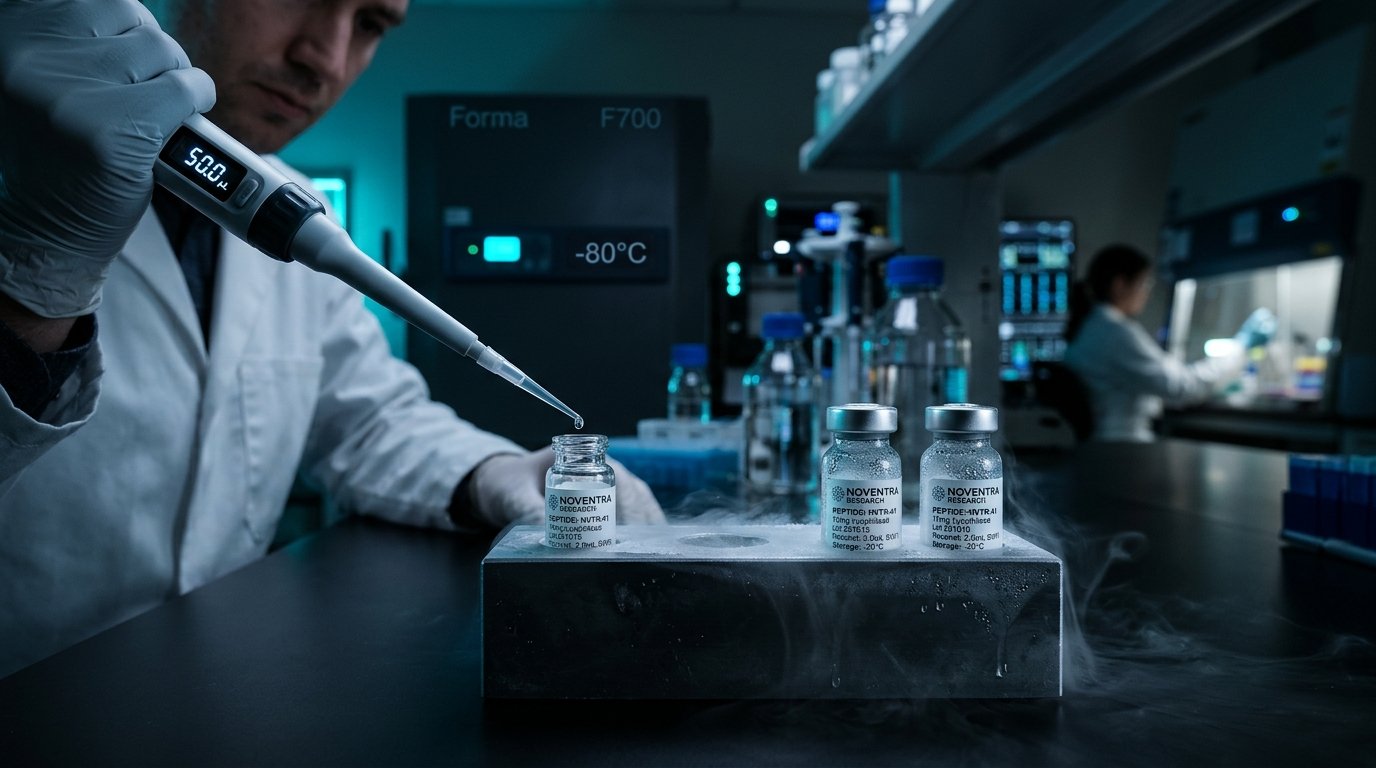
Standard operating procedures for reconstituting lyophilized research peptides, preserving primary amino acid chains against shear degradation, and ensuring strict cold-chain viability compliance.
LAB PROTOCOL ARCHIVE // SOP-REC-04
Select or enter the vial peptide mass and BAC water diluent volume to calculate instant solution concentration and U-100 insulin syringe unit equivalents.
Preserving tertiary protein and peptide structures requires strict adhering to thermal storage parameters across solid and liquid phases.
Store in original vacuum-sealed borosilicate glass. Protect from moisture and repeated thermal fluctuations.
Store reconstituted vials upright in a dedicated dark cold-storage box. Do not allow to freeze once reconstituted.
Tolerated during courier transit for dry lyophilized powder. Avoid direct sunlight and transfer to -20°C upon arrival.
Gentle handling prevents peptide bond cleavage and preserves tertiary macromolecular structures.
Wipe rubber septa with 70% isopropyl alcohol. Allow to dry 30 seconds to maintain an aseptic boundary.
Aim needle against the inner glass wall. Allow diluent to run gently down the side without forceful jetting.
Roll vial slowly between palms until dissolved. Never vortex or shake vigorously to prevent shearing.
Inspect against backlight. Solution must be clear and homogeneous before refrigerated storage at 2°C-8°C.
Choosing the correct diluent depends on compound hydrophobicity, isoelectric point, and required shelf life.
Contains 0.9% benzyl alcohol as an antibacterial bacteriostatic agent. Essential for multiple punctures over 28-40 days.
Preservative-free sterile water. Because it lacks benzyl alcohol, any reconstituted volume must be used or discarded within 24 hours.
Used for basic or hydrophobic peptides that aggregate in neutral pH water. A few drops ensure complete dissolution prior to BAC dilution.
Our laboratory team is available to assist research institutions with compound solubility curves, CoA authentication, and cold chain handling inquiries.

All products sold on this site are supplied strictly for in-vitro laboratory research and are not for human or veterinary use. Not a drug, food, cosmetic, or dietary supplement. Not for diagnostic or therapeutic use. Access is limited to qualified researchers.
IF YOU DO NOT AGREE, PLEASE LEAVE THIS SITE.